


Last Updated: November 10, 2026
Quick Summary
The I-526 processing time is not one fixed number. USCIS publishes estimates for completed cases, usually covering the window roughly 80% of recently finished petitions took, so your own wait can fall outside that range. Check the USCIS case processing times tool using your filing date for the current estimate.
- The EB-5 investor visa offers a pathway to permanent residency through a qualifying investment that creates U.S. jobs..
- International Creative Capital is a USCIS-authorized EB-5 Regional Center offering one-on-one guidance.
- Its Residences at Custom House & Hotel project was completed in 2016, with all I-526 petitions approved for 33 investors.
- Its current EB-5 project, Canopy Minneapolis Mill District, is a completed and operating hotel that has exceeded job creation requirements for all available investor slots and received multiple I-526E petition approvals.
Table of Contents
- What USCIS Processing-Time Estimates Actually Measure
- Standalone I-526 vs. Regional Center I-526E Timelines
- I-526 and I-526E Processing Times: Key Takeaways
- I-526 Processing Time Factors That Change Your Wait
- How to Check Your I-526 Case Status and Interpret the Results
- What Happens After I-526 Approval and Your Next Steps
- Scheduling Your Free Consultation to Plan Your EB-5 Timeline
- Frequently Asked Questions
Investors planning their EB-5 timeline often ask one question more than any other: what is the I-526 processing time for a petition? The honest answer is that no single number fits every case. USCIS publishes processing-time estimates, but those figures describe a slice of the process, not a guaranteed date. Understanding what they measure is the first step toward a realistic plan for the EB-5 visa.
Here is the core of this guide. The official estimate tells you how long most recently completed cases took. It does not promise your case will finish on that schedule. Many investors find that the gap between the published figure and their own wait causes stress, so it helps to know what the numbers mean before you rely on them.
What USCIS Processing-Time Estimates Actually Measure
USCIS reports processing times as a range, and that range reflects completed cases. In practice, the agency’s estimate usually covers the period that roughly 80% of recently finished cases took to complete. The remaining cases can fall outside that window.
The estimate also depends on the case inquiry date, not just the day you filed. A case that has been pending longer than the stated range may still be normal, especially when requests for evidence add time.
Official Estimates vs. Third-Party Timelines
You will find many EB-5 articles and forum posts offering their own timelines for 2026. Some of these are useful, but treat them as anecdotes rather than official guidance. Official figures come from USCIS Case Processing Times. Third-party numbers may reflect a small sample, an older period, or a different project type.
Use USCIS as your baseline, and use outside estimates only to ask better questions.
Standalone I-526 vs. Regional Center I-526E Timelines
EB-5 investors file Form I-526 for standalone (direct) investments or Form I-526E for investments through a USCIS-designated regional center. These pathways have different project structures, job-creation requirements, and adjudication considerations.
- Standalone I-526 (direct): Investors must document the lawful source of their investment funds and demonstrate that the new commercial enterprise will create at least 10 qualifying direct, full-time jobs. Indirect and induced jobs cannot satisfy this requirement.
- Regional Center I-526E: Investors participate in projects sponsored by USCIS-designated regional centers. These projects may count qualifying direct, indirect, and induced jobs, subject to applicable USCIS requirements.
Neither filing pathway guarantees faster approval. Processing times can vary based on USCIS workload, petition complexity, visa availability, and applicable processing priorities.
I-526 and I-526E Processing Times: Key Takeaways
Processing times for Form I-526 and Form I-526E vary based on several factors, and no single timeline applies to every EB-5 petition. USCIS publishes historical processing data to help investors understand general timeframes, but individual cases may be approved sooner or require additional time. Investors should consult the USCIS Case Processing Times tool for the most current information.
- USCIS processing estimates: Published timelines reflect historical adjudication data and do not guarantee when an individual petition will be approved.
- Case inquiry dates: USCIS provides guidance on when a petition may be considered outside normal processing times.
- Requests for Evidence (RFEs): Additional documentation requests can extend processing times. Timely, complete responses help minimize avoidable delays.
- Investment and filing factors: Filing date, project type, visa set-aside category, and USCIS processing priorities can influence timelines.
- Visa availability: Approval of Form I-526 or I-526E does not automatically guarantee immediate green card issuance. Visa availability and other immigration requirements still apply.
I-526 Processing Time Factors That Change Your Wait
Several factors can shift your timeline, even when the published estimate looks steady. Knowing them helps you set expectations.
- Filing category and date: Petitions filed in different periods can move at different speeds.
- Project type: Investments in qualifying high-unemployment Targeted Employment Areas (TEAs) benefit from a dedicated EB-5 visa set-aside, which can affect visa availability and the overall immigration timeline.
- Completeness of the file: Missing documents can slow review.
- Requests for evidence: A request can extend your processing time by weeks or months.
Filing Date, Project Type, and Set-Aside Category
Your filing date can influence your processing timeline. Project type and set-aside category can also affect visa availability and overall immigration timelines. The EB-5 program reserves 10% of available visas for qualifying investments in high-unemployment Targeted Employment Areas (TEAs). This dedicated visa category can provide an important advantage by reducing or eliminating additional waiting periods associated with visa backlogs.
Requests for Evidence and Other Delays
A Request for Evidence, often called an RFE, is one of the common causes of delay. USCIS requests additional documentation when more information is needed. Respond promptly and thoroughly to any requests for additional documentation, working closely with your immigration attorney and benefiting from the hands-on support provided by International Creative Capital throughout the process. A thorough response reduces the risk of additional requests.
How to Check Your I-526 Case Status and Interpret the Results
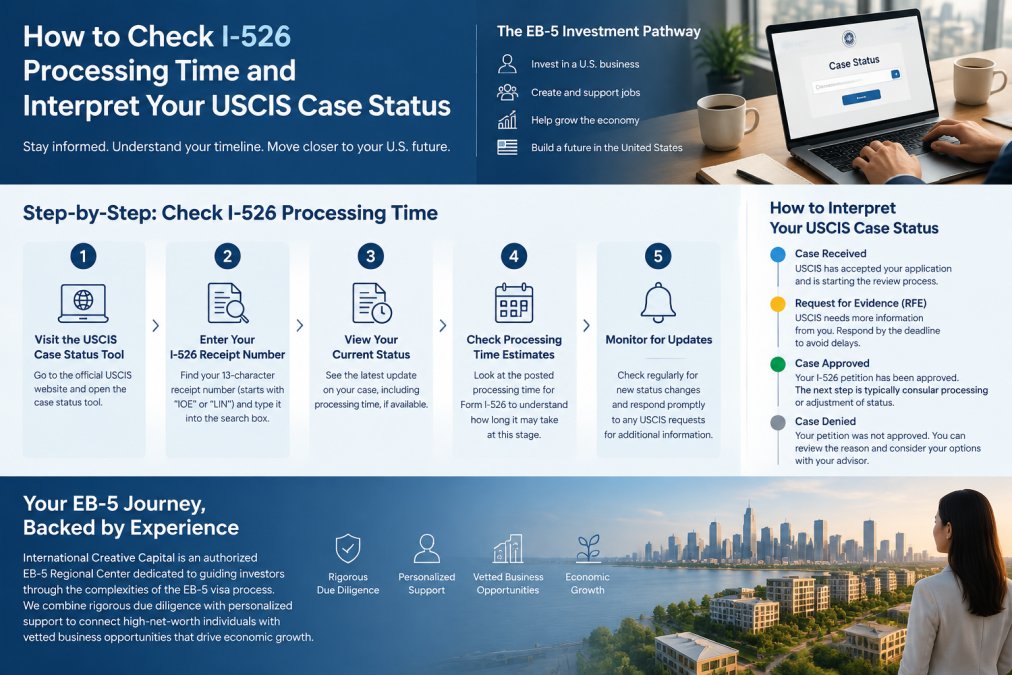
Start with your receipt notice. It shows your receipt number and filing date. Enter that number in the USCIS Case Status Online tool to see the current status.
Next, compare your waiting time with the published processing time. If you are within the estimate, your case is generally within normal processing times. If your case is eligible for an inquiry based on the USCIS case inquiry date, submitting an inquiry may help. Keep a dated record of every notice and update so you can explain your timeline clearly.
What Happens After I-526 Approval and Your Next Steps
Approval of your I-526 or I-526E is a major milestone, but it does not mean your permanent residence is imminent. Petition approval establishes eligibility under the EB-5 classification, but additional immigration requirements must still be satisfied.
Whether you can receive a green card also depends on visa availability, which is determined by your EB-5 investment category, priority date, and the monthly Visa Bulletin published by the U.S. Department of State. Investments in qualifying high-unemployment Targeted Employment Areas (TEAs) benefit from a 10% EB-5 visa set-aside. According to the November 2026 Visa Bulletin, this category is current for all countries, including China and India, meaning there is no visa backlog in this category at this time. This provides a significant advantage over the unreserved EB-5 category, where China and India continue to experience backlogs. Visa availability can change in future bulletins.
For eligible investors already in the United States, concurrent filing allows Form I-485 (Adjustment of Status) to be submitted while Form I-526 or I-526E is pending, provided a visa is available for filing. Investors may also apply for employment authorization (Form I-765) and advance parole (Form I-131), which USCIS can approve before the underlying EB-5 petition. Final approval of Form I-485 generally requires approval of Form I-526 or I-526E.
The main stages after approval are:
- Priority date and visa availability: Your priority date is generally the date your I-526 or I-526E petition was filed. Visa availability depends on your EB-5 investment category and country of chargeability. The EB-5 program reserves 10% of available visas for qualifying investments in high-unemployment Targeted Employment Areas (TEAs). According to the November 2026 Visa Bulletin published by the U.S. Department of State, this set-aside category is current for all countries, including China and India, meaning there is no visa backlog in this category at this time. This allows eligible investors to move forward without waiting for a visa priority date to become current, although USCIS processing and other immigration requirements still apply. Visa availability can change, so investors should review the Visa Bulletin each month.
- Consular processing or adjustment of status: If you are outside the United States, you will generally complete consular processing at a U.S. embassy or consulate. If you are already in the United States and eligible, you may pursue adjustment of status with USCIS, including concurrent filing when permitted. The choice affects timing, travel, and how your dependents are handled, so it should be reviewed with counsel early.
- Conditional permanent residence: Once approved for conditional permanent residence, EB-5 investors and their qualifying family members receive green cards allowing them to live, work, and study in the United States as lawful permanent residents. This initial two-year period provides the benefits of permanent residency while the investor completes the final requirements of the EB-5 program.
- Form I-829 petition: The next step is filing Form I-829, Petition by Investor to Remove Conditions on Permanent Resident Status, during the final 90 days of the two-year conditional residency period. A properly filed petition extends their conditional resident status while USCIS reviews the application. Once approved, the conditions are removed, and the investor and qualifying family members receive standard ten-year green cards.
Putting these together gives a more realistic end-to-end picture. A petition can be approved within the published I-526 or I-526E processing range, but visa availability also plays an important role in the overall timeline. Investors in qualifying high-unemployment Targeted Employment Area (TEA) projects benefit from a reserved visa category, which is currently available to all countries, including China and India, under the November 2026 Visa Bulletin. This can eliminate additional waiting periods associated with visa backlogs, although individual petition processing times and other immigration requirements still apply.
Important: Visa availability can change, so investors should monitor the monthly Visa Bulletin and work closely with their immigration attorney to understand their individual timeline. For investors in the high-unemployment TEA set-aside category, current visa availability provides an important advantage when planning their EB-5 immigration journey.
After approval, keep copies of every notice, track your priority date against the Visa Bulletin each month, and schedule a review with an immigration attorney to confirm which route, consular processing or adjustment of status, fits your situation
The key stages after approval, and how each one affects your timing, are summarised below.
|
Stage |
What it means |
Timing note |
|---|---|---|
|
Priority date |
Generally the I-526 or I-526E filing date |
Check the Visa Bulletin monthly |
|
Visa availability |
Visa number must become current |
Backlog can delay even after approval |
|
Consular processing |
Completed at a U.S. embassy or consulate |
Typical route if outside the U.S. |
|
Adjustment of status |
Filed with USCIS if already lawfully in the U.S. |
Affects travel and dependent handling |
|
Conditional green card |
Valid for two years |
Not the ten-year card |
|
Form I-829 |
Removes conditions on permanent residence |
Filed before the conditional period ends |
Investors and qualifying family members can live, work, and study in the U.S. as lawful permanent residents.
Form I-829 Removes conditions on permanent residence. Filed during the final 90 days of conditional residence; status continues while a properly filed petition is pending.
Permanent Residence Without Conditions Standard ten-year green card issued after I-829 approval. Green card can be renewed; permanent resident status is not limited to ten years.
Scheduling Your Free Consultation to Plan Your EB-5 Timeline
Every investor’s situation is different, and the right timeline depends on your filing, your project, and your goals. International Creative Capital offers a free consultation to review your options. Book your free consultation to discuss your next step.
Frequently Asked Questions
How long does it take to get I-526 approved?
I-526 processing time varies widely, and USCIS publishes processing-time estimates that show how long 80% of cases of a given type take to complete, measured from the case inquiry date. These estimates change over time, so check the current USCIS processing-time tool for your filing category rather than relying on older figures or anecdotal reports. Third-party timelines are often based on small samples and may not reflect your petition’s category or service center. Plan with a range rather than a single date, and remember that processing time is only one part of the total path to permanent residence.
Will USCIS speed up I-526 processing in 2026?
Processing times depend on USCIS adjudication capacity, petition volume, and policy priorities, and none of these can be predicted with certainty. Published estimates are updated periodically and may shorten or lengthen. Rather than assuming a speed-up, track the official processing-time data for your filing category and plan for a range of outcomes. International Creative Capital can review your specific timeline during a free consultation.
What happens after I-526 is approved?
Once an I-526 or I-526E is approved, the investor can proceed to the next stage of the EB-5 process, which depends on whether they are residing abroad or in the United States. Investors abroad typically move to consular processing through the National Visa Center, while those in the U.S. may pursue adjustment of status, subject to visa availability in the EB-5 category. The conditional residence period and the later Form I-829 petition follow. Each step has its own documentation requirements, so review the sequence carefully with your advisors.
How can I check my I-526 case status and processing time?
Start with the receipt notice, which contains your receipt number and the filing date. Use that receipt number on the USCIS case status page to see your current case status. Compare the time your petition has been pending against the USCIS processing-time estimate for your form and applicable filing category. If your EB-5 petition is taking longer than USCIS’s published processing times, you may be eligible to submit an inquiry requesting an update on your case. USCIS provides a case inquiry date to help determine when you can make this request. Keep copies of all USCIS notices and correspondence so you can monitor your case’s progress.
